CHAPTER 62. A LIGHT SHINES ON MY WAY
The year came round to Christmas-time, and I had been at home above two months. I had seen Agnes frequently. However loud the general voice might be in giving me encouragement, and however fervent the emotions and endeavours to which it roused me, I heard her lightest word of praise as I heard nothing else.
At least once a week, and sometimes oftener, I rode over there, and passed the evening. I usually rode back at night; for the old unhappy sense was always hovering about me now—most sorrowfully when I left her—and I was glad to be up and out, rather than wandering over the past in weary wakefulness or miserable dreams. I wore away the longest part of many wild sad nights, in those rides; reviving, as I went, the thoughts that had occupied me in my long absence.
Or, if I were to say rather that I listened to the echoes of those thoughts, I should better express the truth. They spoke to me from afar off. I had put them at a distance, and accepted my inevitable place. When I read to Agnes what I wrote; when I saw her listening face; moved her to smiles or tears; and heard her cordial voice so earnest on the shadowy events of that imaginative world in which I lived; I thought what a fate mine might have been—but only thought so, as I had thought after I was married to Dora, what I could have wished my wife to be.
My duty to Agnes, who loved me with a love, which, if I disquieted, I wronged most selfishly and poorly, and could never restore; my matured assurance that I, who had worked out my own destiny, and won what I had impetuously set my heart on, had no right to murmur, and must bear; comprised what I felt and what I had learned. But I loved her: and now it even became some consolation to me, vaguely to conceive a distant day when I might blamelessly avow it; when all this should be over; when I could say ‘Agnes, so it was when I came home; and now I am old, and I never have loved since!’
She did not once show me any change in herself. What she always had been to me, she still was; wholly unaltered.
Between my aunt and me there had been something, in this connexion, since the night of my return, which I cannot call a restraint, or an avoidance of the subject, so much as an implied understanding that we thought of it together, but did not shape our thoughts into words. When, according to our old custom, we sat before the fire at night, we often fell into this train; as naturally, and as consciously to each other, as if we had unreservedly said so. But we preserved an unbroken silence. I believed that she had read, or partly read, my thoughts that night; and that she fully comprehended why I gave mine no more distinct expression.
This Christmas-time being come, and Agnes having reposed no new confidence in me, a doubt that had several times arisen in my mind—whether she could have that perception of the true state of my breast, which restrained her with the apprehension of giving me pain—began to oppress me heavily. If that were so, my sacrifice was nothing; my plainest obligation to her unfulfilled; and every poor action I had shrunk from, I was hourly doing. I resolved to set this right beyond all doubt;—if such a barrier were between us, to break it down at once with a determined hand.
It was—what lasting reason have I to remember it!—a cold, harsh, winter day. There had been snow, some hours before; and it lay, not deep, but hard-frozen on the ground. Out at sea, beyond my window, the wind blew ruggedly from the north. I had been thinking of it, sweeping over those mountain wastes of snow in Switzerland, then inaccessible to any human foot; and had been speculating which was the lonelier, those solitary regions, or a deserted ocean.
‘Riding today, Trot?’ said my aunt, putting her head in at the door.
‘Yes,’ said I, ‘I am going over to Canterbury. It’s a good day for a ride.’
‘I hope your horse may think so too,’ said my aunt; ‘but at present he is holding down his head and his ears, standing before the door there, as if he thought his stable preferable.’
My aunt, I may observe, allowed my horse on the forbidden ground, but had not at all relented towards the donkeys.
‘He will be fresh enough, presently!’ said I.
‘The ride will do his master good, at all events,’ observed my aunt, glancing at the papers on my table. ‘Ah, child, you pass a good many hours here! I never thought, when I used to read books, what work it was to write them.’
‘It’s work enough to read them, sometimes,’ I returned. ‘As to the writing, it has its own charms, aunt.’
‘Ah! I see!’ said my aunt. ‘Ambition, love of approbation, sympathy, and much more, I suppose? Well: go along with you!’
‘Do you know anything more,’ said I, standing composedly before her—she had patted me on the shoulder, and sat down in my chair—‘of that attachment of Agnes?’
She looked up in my face a little while, before replying:
‘I think I do, Trot.’
‘Are you confirmed in your impression?’ I inquired.
‘I think I am, Trot.’
She looked so steadfastly at me: with a kind of doubt, or pity, or suspense in her affection: that I summoned the stronger determination to show her a perfectly cheerful face.
‘And what is more, Trot—’ said my aunt.
‘Yes!’
‘I think Agnes is going to be married.’
‘God bless her!’ said I, cheerfully.
‘God bless her!’ said my aunt, ‘and her husband too!’
I echoed it, parted from my aunt, and went lightly downstairs, mounted, and rode away. There was greater reason than before to do what I had resolved to do.
How well I recollect the wintry ride! The frozen particles of ice, brushed from the blades of grass by the wind, and borne across my face; the hard clatter of the horse’s hoofs, beating a tune upon the ground; the stiff-tilled soil; the snowdrift, lightly eddying in the chalk-pit as the breeze ruffled it; the smoking team with the waggon of old hay, stopping to breathe on the hill-top, and shaking their bells musically; the whitened slopes and sweeps of Down-land lying against the dark sky, as if they were drawn on a huge slate!
I found Agnes alone. The little girls had gone to their own homes now, and she was alone by the fire, reading. She put down her book on seeing me come in; and having welcomed me as usual, took her work-basket and sat in one of the old-fashioned windows.
I sat beside her on the window-seat, and we talked of what I was doing, and when it would be done, and of the progress I had made since my last visit. Agnes was very cheerful; and laughingly predicted that I should soon become too famous to be talked to, on such subjects.
‘So I make the most of the present time, you see,’ said Agnes, ‘and talk to you while I may.’
As I looked at her beautiful face, observant of her work, she raised her mild clear eyes, and saw that I was looking at her.
‘You are thoughtful today, Trotwood!’
‘Agnes, shall I tell you what about? I came to tell you.’
She put aside her work, as she was used to do when we were seriously discussing anything; and gave me her whole attention.
‘My dear Agnes, do you doubt my being true to you?’
‘No!’ she answered, with a look of astonishment.
‘Do you doubt my being what I always have been to you?’
‘No!’ she answered, as before.
‘Do you remember that I tried to tell you, when I came home, what a debt of gratitude I owed you, dearest Agnes, and how fervently I felt towards you?’
‘I remember it,’ she said, gently, ‘very well.’
‘You have a secret,’ said I. ‘Let me share it, Agnes.’
She cast down her eyes, and trembled.
‘I could hardly fail to know, even if I had not heard—but from other lips than yours, Agnes, which seems strange—that there is someone upon whom you have bestowed the treasure of your love. Do not shut me out of what concerns your happiness so nearly! If you can trust me, as you say you can, and as I know you may, let me be your friend, your brother, in this matter, of all others!’
With an appealing, almost a reproachful, glance, she rose from the window; and hurrying across the room as if without knowing where, put her hands before her face, and burst into such tears as smote me to the heart.
And yet they awakened something in me, bringing promise to my heart. Without my knowing why, these tears allied themselves with the quietly sad smile which was so fixed in my remembrance, and shook me more with hope than fear or sorrow.
‘Agnes! Sister! Dearest! What have I done?’
‘Let me go away, Trotwood. I am not well. I am not myself. I will speak to you by and by—another time. I will write to you. Don’t speak to me now. Don’t! don’t!’
I sought to recollect what she had said, when I had spoken to her on that former night, of her affection needing no return. It seemed a very world that I must search through in a moment. ‘Agnes, I cannot bear to see you so, and think that I have been the cause. My dearest girl, dearer to me than anything in life, if you are unhappy, let me share your unhappiness. If you are in need of help or counsel, let me try to give it to you. If you have indeed a burden on your heart, let me try to lighten it. For whom do I live now, Agnes, if it is not for you!’
‘Oh, spare me! I am not myself! Another time!’ was all I could distinguish.
Was it a selfish error that was leading me away? Or, having once a clue to hope, was there something opening to me that I had not dared to think of?
‘I must say more. I cannot let you leave me so! For Heaven’s sake, Agnes, let us not mistake each other after all these years, and all that has come and gone with them! I must speak plainly. If you have any lingering thought that I could envy the happiness you will confer; that I could not resign you to a dearer protector, of your own choosing; that I could not, from my removed place, be a contented witness of your joy; dismiss it, for I don’t deserve it! I have not suffered quite in vain. You have not taught me quite in vain. There is no alloy of self in what I feel for you.’
She was quiet now. In a little time, she turned her pale face towards me, and said in a low voice, broken here and there, but very clear:
‘I owe it to your pure friendship for me, Trotwood—which, indeed, I do not doubt—to tell you, you are mistaken. I can do no more. If I have sometimes, in the course of years, wanted help and counsel, they have come to me. If I have sometimes been unhappy, the feeling has passed away. If I have ever had a burden on my heart, it has been lightened for me. If I have any secret, it is—no new one; and is—not what you suppose. I cannot reveal it, or divide it. It has long been mine, and must remain mine.’
‘Agnes! Stay! A moment!’
She was going away, but I detained her. I clasped my arm about her waist. ‘In the course of years!’ ‘It is not a new one!’ New thoughts and hopes were whirling through my mind, and all the colours of my life were changing.
‘Dearest Agnes! Whom I so respect and honour—whom I so devotedly love! When I came here today, I thought that nothing could have wrested this confession from me. I thought I could have kept it in my bosom all our lives, till we were old. But, Agnes, if I have indeed any new-born hope that I may ever call you something more than Sister, widely different from Sister!—’
Her tears fell fast; but they were not like those she had lately shed, and I saw my hope brighten in them.
‘Agnes! Ever my guide, and best support! If you had been more mindful of yourself, and less of me, when we grew up here together, I think my heedless fancy never would have wandered from you. But you were so much better than I, so necessary to me in every boyish hope and disappointment, that to have you to confide in, and rely upon in everything, became a second nature, supplanting for the time the first and greater one of loving you as I do!’
Still weeping, but not sadly—joyfully! And clasped in my arms as she had never been, as I had thought she never was to be!
‘When I loved Dora—fondly, Agnes, as you know—’
‘Yes!’ she cried, earnestly. ‘I am glad to know it!’
‘When I loved her—even then, my love would have been incomplete, without your sympathy. I had it, and it was perfected. And when I lost her, Agnes, what should I have been without you, still!’
Closer in my arms, nearer to my heart, her trembling hand upon my shoulder, her sweet eyes shining through her tears, on mine!
‘I went away, dear Agnes, loving you. I stayed away, loving you. I returned home, loving you!’
And now, I tried to tell her of the struggle I had had, and the conclusion I had come to. I tried to lay my mind before her, truly, and entirely. I tried to show her how I had hoped I had come into the better knowledge of myself and of her; how I had resigned myself to what that better knowledge brought; and how I had come there, even that day, in my fidelity to this. If she did so love me (I said) that she could take me for her husband, she could do so, on no deserving of mine, except upon the truth of my love for her, and the trouble in which it had ripened to be what it was; and hence it was that I revealed it. And O, Agnes, even out of thy true eyes, in that same time, the spirit of my child-wife looked upon me, saying it was well; and winning me, through thee, to tenderest recollections of the Blossom that had withered in its bloom!
‘I am so blest, Trotwood—my heart is so overcharged—but there is one thing I must say.’
‘Dearest, what?’
She laid her gentle hands upon my shoulders, and looked calmly in my face.
‘Do you know, yet, what it is?’
‘I am afraid to speculate on what it is. Tell me, my dear.’
‘I have loved you all my life!’
O, we were happy, we were happy! Our tears were not for the trials (hers so much the greater) through which we had come to be thus, but for the rapture of being thus, never to be divided more!
We walked, that winter evening, in the fields together; and the blessed calm within us seemed to be partaken by the frosty air. The early stars began to shine while we were lingering on, and looking up to them, we thanked our GOD for having guided us to this tranquillity.
We stood together in the same old-fashioned window at night, when the moon was shining; Agnes with her quiet eyes raised up to it; I following her glance. Long miles of road then opened out before my mind; and, toiling on, I saw a ragged way-worn boy, forsaken and neglected, who should come to call even the heart now beating against mine, his own.
It was nearly dinner-time next day when we appeared before my aunt. She was up in my study, Peggotty said: which it was her pride to keep in readiness and order for me. We found her, in her spectacles, sitting by the fire.
‘Goodness me!’ said my aunt, peering through the dusk, ‘who’s this you’re bringing home?’
‘Agnes,’ said I.
As we had arranged to say nothing at first, my aunt was not a little discomfited. She darted a hopeful glance at me, when I said ‘Agnes’; but seeing that I looked as usual, she took off her spectacles in despair, and rubbed her nose with them.
She greeted Agnes heartily, nevertheless; and we were soon in the lighted parlour downstairs, at dinner. My aunt put on her spectacles twice or thrice, to take another look at me, but as often took them off again, disappointed, and rubbed her nose with them. Much to the discomfiture of Mr. Dick, who knew this to be a bad symptom.
‘By the by, aunt,’ said I, after dinner; ‘I have been speaking to Agnes about what you told me.’
‘Then, Trot,’ said my aunt, turning scarlet, ‘you did wrong, and broke your promise.’
‘You are not angry, aunt, I trust? I am sure you won’t be, when you learn that Agnes is not unhappy in any attachment.’
‘Stuff and nonsense!’ said my aunt.
As my aunt appeared to be annoyed, I thought the best way was to cut her annoyance short. I took Agnes in my arm to the back of her chair, and we both leaned over her. My aunt, with one clap of her hands, and one look through her spectacles, immediately went into hysterics, for the first and only time in all my knowledge of her.
The hysterics called up Peggotty. The moment my aunt was restored, she flew at Peggotty, and calling her a silly old creature, hugged her with all her might. After that, she hugged Mr. Dick (who was highly honoured, but a good deal surprised); and after that, told them why. Then, we were all happy together.
I could not discover whether my aunt, in her last short conversation with me, had fallen on a pious fraud, or had really mistaken the state of my mind. It was quite enough, she said, that she had told me Agnes was going to be married; and that I now knew better than anyone how true it was.
We were married within a fortnight. Traddles and Sophy, and Doctor and Mrs. Strong, were the only guests at our quiet wedding. We left them full of joy; and drove away together. Clasped in my embrace, I held the source of every worthy aspiration I had ever had; the centre of myself, the circle of my life, my own, my wife; my love of whom was founded on a rock!
‘Dearest husband!’ said Agnes. ‘Now that I may call you by that name, I have one thing more to tell you.’
‘Let me hear it, love.’
‘It grows out of the night when Dora died. She sent you for me.’
‘She did.’
‘She told me that she left me something. Can you think what it was?’
I believed I could. I drew the wife who had so long loved me, closer to my side.
‘She told me that she made a last request to me, and left me a last charge.’
‘And it was—’
‘That only I would occupy this vacant place.’
And Agnes laid her head upon my breast, and wept; and I wept with her, though we were so happy.
What I have purposed to record is nearly finished; but there is yet an incident conspicuous in my memory, on which it often rests with delight, and without which one thread in the web I have spun would have a ravelled end.
I had advanced in fame and fortune, my domestic joy was perfect, I had been married ten happy years. Agnes and I were sitting by the fire, in our house in London, one night in spring, and three of our children were playing in the room, when I was told that a stranger wished to see me.
He had been asked if he came on business, and had answered No; he had come for the pleasure of seeing me, and had come a long way. He was an old man, my servant said, and looked like a farmer.
As this sounded mysterious to the children, and moreover was like the beginning of a favourite story Agnes used to tell them, introductory to the arrival of a wicked old Fairy in a cloak who hated everybody, it produced some commotion. One of our boys laid his head in his mother’s lap to be out of harm’s way, and little Agnes (our eldest child) left her doll in a chair to represent her, and thrust out her little heap of golden curls from between the window-curtains, to see what happened next.
‘Let him come in here!’ said I.
There soon appeared, pausing in the dark doorway as he entered, a hale, grey-haired old man. Little Agnes, attracted by his looks, had run to bring him in, and I had not yet clearly seen his face, when my wife, starting up, cried out to me, in a pleased and agitated voice, that it was Mr. Peggotty!
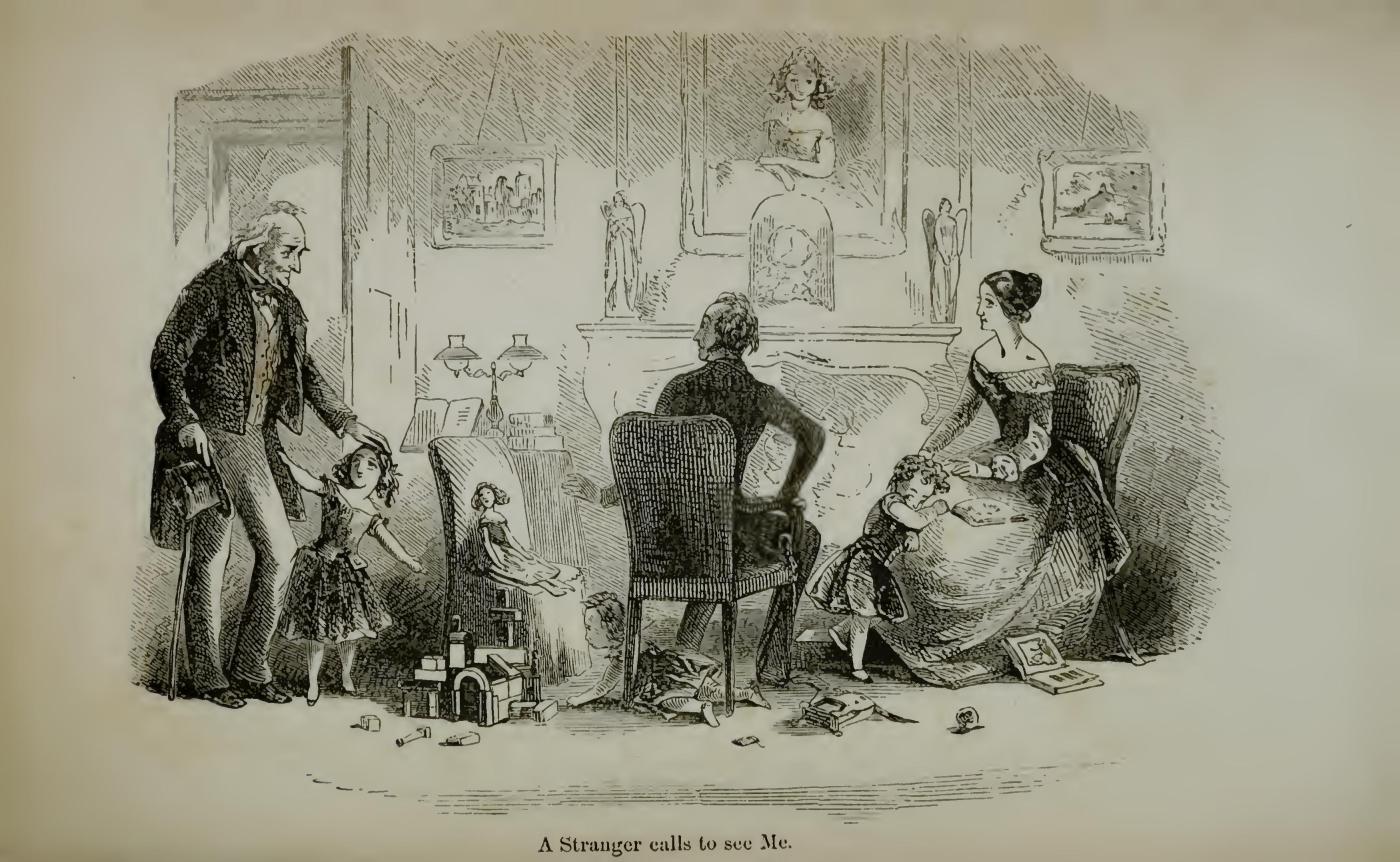
It WAS Mr. Peggotty. An old man now, but in a ruddy, hearty, strong old age. When our first emotion was over, and he sat before the fire with the children on his knees, and the blaze shining on his face, he looked, to me, as vigorous and robust, withal as handsome, an old man, as ever I had seen.
‘Mas’r Davy,’ said he. And the old name in the old tone fell so naturally on my ear! ‘Mas’r Davy, ‘tis a joyful hour as I see you, once more, ‘long with your own trew wife!’
‘A joyful hour indeed, old friend!’ cried I.
‘And these heer pretty ones,’ said Mr. Peggotty. ‘To look at these heer flowers! Why, Mas’r Davy, you was but the heighth of the littlest of these, when I first see you! When Em’ly warn’t no bigger, and our poor lad were BUT a lad!’
‘Time has changed me more than it has changed you since then,’ said I. ‘But let these dear rogues go to bed; and as no house in England but this must hold you, tell me where to send for your luggage (is the old black bag among it, that went so far, I wonder!), and then, over a glass of Yarmouth grog, we will have the tidings of ten years!’
‘Are you alone?’ asked Agnes.
‘Yes, ma’am,’ he said, kissing her hand, ‘quite alone.’
We sat him between us, not knowing how to give him welcome enough; and as I began to listen to his old familiar voice, I could have fancied he was still pursuing his long journey in search of his darling niece.
‘It’s a mort of water,’ said Mr. Peggotty, ‘fur to come across, and on’y stay a matter of fower weeks. But water (‘specially when ‘tis salt) comes nat’ral to me; and friends is dear, and I am heer. —Which is verse,’ said Mr. Peggotty, surprised to find it out, ‘though I hadn’t such intentions.’
‘Are you going back those many thousand miles, so soon?’ asked Agnes.
‘Yes, ma’am,’ he returned. ‘I giv the promise to Em’ly, afore I come away. You see, I doen’t grow younger as the years comes round, and if I hadn’t sailed as ‘twas, most like I shouldn’t never have done ‘t. And it’s allus been on my mind, as I must come and see Mas’r Davy and your own sweet blooming self, in your wedded happiness, afore I got to be too old.’
He looked at us, as if he could never feast his eyes on us sufficiently. Agnes laughingly put back some scattered locks of his grey hair, that he might see us better.
‘And now tell us,’ said I, ‘everything relating to your fortunes.’
‘Our fortuns, Mas’r Davy,’ he rejoined, ‘is soon told. We haven’t fared nohows, but fared to thrive. We’ve allus thrived. We’ve worked as we ought to ‘t, and maybe we lived a leetle hard at first or so, but we have allus thrived. What with sheep-farming, and what with stock-farming, and what with one thing and what with t’other, we are as well to do, as well could be. Theer’s been kiender a blessing fell upon us,’ said Mr. Peggotty, reverentially inclining his head, ‘and we’ve done nowt but prosper. That is, in the long run. If not yesterday, why then today. If not today, why then tomorrow.’
‘And Emily?’ said Agnes and I, both together.
‘Em’ly,’ said he, ‘arter you left her, ma’am—and I never heerd her saying of her prayers at night, t’other side the canvas screen, when we was settled in the Bush, but what I heerd your name—and arter she and me lost sight of Mas’r Davy, that theer shining sundown—was that low, at first, that, if she had know’d then what Mas’r Davy kep from us so kind and thowtful, ‘tis my opinion she’d have drooped away. But theer was some poor folks aboard as had illness among ‘em, and she took care of them; and theer was the children in our company, and she took care of them; and so she got to be busy, and to be doing good, and that helped her.’
‘When did she first hear of it?’ I asked.
‘I kep it from her arter I heerd on ‘t,’ said Mr. Peggotty, ‘going on nigh a year. We was living then in a solitary place, but among the beautifullest trees, and with the roses a-covering our Beein to the roof. Theer come along one day, when I was out a-working on the land, a traveller from our own Norfolk or Suffolk in England (I doen’t rightly mind which), and of course we took him in, and giv him to eat and drink, and made him welcome. We all do that, all the colony over. He’d got an old newspaper with him, and some other account in print of the storm. That’s how she know’d it. When I came home at night, I found she know’d it.’
He dropped his voice as he said these words, and the gravity I so well remembered overspread his face.
‘Did it change her much?’ we asked.
‘Aye, for a good long time,’ he said, shaking his head; ‘if not to this present hour. But I think the solitoode done her good. And she had a deal to mind in the way of poultry and the like, and minded of it, and come through. I wonder,’ he said thoughtfully, ‘if you could see my Em’ly now, Mas’r Davy, whether you’d know her!’
‘Is she so altered?’ I inquired.
‘I doen’t know. I see her ev’ry day, and doen’t know; But, odd-times, I have thowt so. A slight figure,’ said Mr. Peggotty, looking at the fire, ‘kiender worn; soft, sorrowful, blue eyes; a delicate face; a pritty head, leaning a little down; a quiet voice and way—timid a’most. That’s Em’ly!’
We silently observed him as he sat, still looking at the fire.
‘Some thinks,’ he said, ‘as her affection was ill-bestowed; some, as her marriage was broken off by death. No one knows how ‘tis. She might have married well, a mort of times, “but, uncle,” she says to me, “that’s gone for ever.” Cheerful along with me; retired when others is by; fond of going any distance fur to teach a child, or fur to tend a sick person, or fur to do some kindness tow’rds a young girl’s wedding (and she’s done a many, but has never seen one); fondly loving of her uncle; patient; liked by young and old; sowt out by all that has any trouble. That’s Em’ly!’
He drew his hand across his face, and with a half-suppressed sigh looked up from the fire.
‘Is Martha with you yet?’ I asked.
‘Martha,’ he replied, ‘got married, Mas’r Davy, in the second year. A young man, a farm-labourer, as come by us on his way to market with his mas’r’s drays—a journey of over five hundred mile, theer and back—made offers fur to take her fur his wife (wives is very scarce theer), and then to set up fur their two selves in the Bush. She spoke to me fur to tell him her trew story. I did. They was married, and they live fower hundred mile away from any voices but their own and the singing birds.’
‘Mrs. Gummidge?’ I suggested.
It was a pleasant key to touch, for Mr. Peggotty suddenly burst into a roar of laughter, and rubbed his hands up and down his legs, as he had been accustomed to do when he enjoyed himself in the long-shipwrecked boat.
‘Would you believe it!’ he said. ‘Why, someun even made offer fur to marry her! If a ship’s cook that was turning settler, Mas’r Davy, didn’t make offers fur to marry Missis Gummidge, I’m Gormed—and I can’t say no fairer than that!’
I never saw Agnes laugh so. This sudden ecstasy on the part of Mr. Peggotty was so delightful to her, that she could not leave off laughing; and the more she laughed the more she made me laugh, and the greater Mr. Peggotty’s ecstasy became, and the more he rubbed his legs.
‘And what did Mrs. Gummidge say?’ I asked, when I was grave enough.
‘If you’ll believe me,’ returned Mr. Peggotty, ‘Missis Gummidge, ‘stead of saying “thank you, I’m much obleeged to you, I ain’t a-going fur to change my condition at my time of life,” up’d with a bucket as was standing by, and laid it over that theer ship’s cook’s head ‘till he sung out fur help, and I went in and reskied of him.’
Mr. Peggotty burst into a great roar of laughter, and Agnes and I both kept him company.
‘But I must say this, for the good creetur,’ he resumed, wiping his face, when we were quite exhausted; ‘she has been all she said she’d be to us, and more. She’s the willingest, the trewest, the honestest-helping woman, Mas’r Davy, as ever draw’d the breath of life. I have never know’d her to be lone and lorn, for a single minute, not even when the colony was all afore us, and we was new to it. And thinking of the old ‘un is a thing she never done, I do assure you, since she left England!’
‘Now, last, not least, Mr. Micawber,’ said I. ‘He has paid off every obligation he incurred here—even to Traddles’s bill, you remember my dear Agnes—and therefore we may take it for granted that he is doing well. But what is the latest news of him?’
Mr. Peggotty, with a smile, put his hand in his breast-pocket, and produced a flat-folded, paper parcel, from which he took out, with much care, a little odd-looking newspaper.
‘You are to understan’, Mas’r Davy,’ said he, ‘as we have left the Bush now, being so well to do; and have gone right away round to Port Middlebay Harbour, wheer theer’s what we call a town.’
‘Mr. Micawber was in the Bush near you?’ said I.
‘Bless you, yes,’ said Mr. Peggotty, ‘and turned to with a will. I never wish to meet a better gen’l’man for turning to with a will. I’ve seen that theer bald head of his a perspiring in the sun, Mas’r Davy, till I a’most thowt it would have melted away. And now he’s a Magistrate.’
‘A Magistrate, eh?’ said I.
Mr. Peggotty pointed to a certain paragraph in the newspaper, where I read aloud as follows, from the Port Middlebay Times:
‘The public dinner to our distinguished fellow-colonist and townsman, WILKINS MICAWBER, ESQUIRE, Port Middlebay District Magistrate, came off yesterday in the large room of the Hotel, which was crowded to suffocation. It is estimated that not fewer than forty-seven persons must have been accommodated with dinner at one time, exclusive of the company in the passage and on the stairs. The beauty, fashion, and exclusiveness of Port Middlebay, flocked to do honour to one so deservedly esteemed, so highly talented, and so widely popular. Doctor Mell (of Colonial Salem-House Grammar School, Port Middlebay) presided, and on his right sat the distinguished guest. After the removal of the cloth, and the singing of Non Nobis (beautifully executed, and in which we were at no loss to distinguish the bell-like notes of that gifted amateur, WILKINS MICAWBER, ESQUIRE, JUNIOR), the usual loyal and patriotic toasts were severally given and rapturously received. Doctor Mell, in a speech replete with feeling, then proposed “Our distinguished Guest, the ornament of our town. May he never leave us but to better himself, and may his success among us be such as to render his bettering himself impossible!” The cheering with which the toast was received defies description. Again and again it rose and fell, like the waves of ocean. At length all was hushed, and WILKINS MICAWBER, ESQUIRE, presented himself to return thanks. Far be it from us, in the present comparatively imperfect state of the resources of our establishment, to endeavour to follow our distinguished townsman through the smoothly-flowing periods of his polished and highly-ornate address! Suffice it to observe, that it was a masterpiece of eloquence; and that those passages in which he more particularly traced his own successful career to its source, and warned the younger portion of his auditory from the shoals of ever incurring pecuniary liabilities which they were unable to liquidate, brought a tear into the manliest eye present. The remaining toasts were DOCTOR MELL; Mrs. MICAWBER (who gracefully bowed her acknowledgements from the side-door, where a galaxy of beauty was elevated on chairs, at once to witness and adorn the gratifying scene), Mrs. RIDGER BEGS (late Miss Micawber); Mrs. MELL; WILKINS MICAWBER, ESQUIRE, JUNIOR (who convulsed the assembly by humorously remarking that he found himself unable to return thanks in a speech, but would do so, with their permission, in a song); Mrs. MICAWBER’S FAMILY (well known, it is needless to remark, in the mother-country), &c. &c. &c. At the conclusion of the proceedings the tables were cleared as if by art-magic for dancing. Among the votaries of TERPSICHORE, who disported themselves until Sol gave warning for departure, Wilkins Micawber, Esquire, Junior, and the lovely and accomplished Miss Helena, fourth daughter of Doctor Mell, were particularly remarkable.’
I was looking back to the name of Doctor Mell, pleased to have discovered, in these happier circumstances, Mr. Mell, formerly poor pinched usher to my Middlesex magistrate, when Mr. Peggotty pointing to another part of the paper, my eyes rested on my own name, and I read thus:
‘TO DAVID COPPERFIELD, ESQUIRE,
‘THE EMINENT AUTHOR.
‘My Dear Sir,
‘Years have elapsed, since I had an opportunity of ocularly perusing the lineaments, now familiar to the imaginations of a considerable portion of the civilized world.
‘But, my dear Sir, though estranged (by the force of circumstances over which I have had no control) from the personal society of the friend and companion of my youth, I have not been unmindful of his soaring flight. Nor have I been debarred,
Though seas between us braid ha’ roared,
(BURNS) from participating in the intellectual feasts he has spread before us.
‘I cannot, therefore, allow of the departure from this place of an individual whom we mutually respect and esteem, without, my dear Sir, taking this public opportunity of thanking you, on my own behalf, and, I may undertake to add, on that of the whole of the Inhabitants of Port Middlebay, for the gratification of which you are the ministering agent.
‘Go on, my dear Sir! You are not unknown here, you are not unappreciated. Though “remote”, we are neither “unfriended”, “melancholy”, nor (I may add) “slow”. Go on, my dear Sir, in your Eagle course! The inhabitants of Port Middlebay may at least aspire to watch it, with delight, with entertainment, with instruction!
‘Among the eyes elevated towards you from this portion of the globe, will ever be found, while it has light and life,
‘The
‘Eye
‘Appertaining to
‘WILKINS MICAWBER,
‘Magistrate.’
I found, on glancing at the remaining contents of the newspaper, that Mr. Micawber was a diligent and esteemed correspondent of that journal. There was another letter from him in the same paper, touching a bridge; there was an advertisement of a collection of similar letters by him, to be shortly republished, in a neat volume, ‘with considerable additions’; and, unless I am very much mistaken, the Leading Article was his also.
We talked much of Mr. Micawber, on many other evenings while Mr. Peggotty remained with us. He lived with us during the whole term of his stay,—which, I think, was something less than a month,—and his sister and my aunt came to London to see him. Agnes and I parted from him aboard-ship, when he sailed; and we shall never part from him more, on earth.
But before he left, he went with me to Yarmouth, to see a little tablet I had put up in the churchyard to the memory of Ham. While I was copying the plain inscription for him at his request, I saw him stoop, and gather a tuft of grass from the grave and a little earth.
‘For Em’ly,’ he said, as he put it in his breast. ‘I promised, Mas’r Davy.’