David Copperfield
CHAPTER 57. THE EMIGRANTS
One thing more, I had to do, before yielding myself to the shock of these emotions. It was, to conceal what had occurred, from those who were going away; and to dismiss them on their voyage in happy ignorance. In this, no time was to be lost.
I took Mr. Micawber aside that same night, and confided to him the task of standing between Mr. Peggotty and intelligence of the late catastrophe. He zealously undertook to do so, and to intercept any newspaper through which it might, without such precautions, reach him.
‘If it penetrates to him, sir,’ said Mr. Micawber, striking himself on the breast, ‘it shall first pass through this body!’
Mr. Micawber, I must observe, in his adaptation of himself to a new state of society, had acquired a bold buccaneering air, not absolutely lawless, but defensive and prompt. One might have supposed him a child of the wilderness, long accustomed to live out of the confines of civilization, and about to return to his native wilds.
He had provided himself, among other things, with a complete suit of oilskin, and a straw hat with a very low crown, pitched or caulked on the outside. In this rough clothing, with a common mariner’s telescope under his arm, and a shrewd trick of casting up his eye at the sky as looking out for dirty weather, he was far more nautical, after his manner, than Mr. Peggotty. His whole family, if I may so express it, were cleared for action. I found Mrs. Micawber in the closest and most uncompromising of bonnets, made fast under the chin; and in a shawl which tied her up (as I had been tied up, when my aunt first received me) like a bundle, and was secured behind at the waist, in a strong knot. Miss Micawber I found made snug for stormy weather, in the same manner; with nothing superfluous about her. Master Micawber was hardly visible in a Guernsey shirt, and the shaggiest suit of slops I ever saw; and the children were done up, like preserved meats, in impervious cases. Both Mr. Micawber and his eldest son wore their sleeves loosely turned back at the wrists, as being ready to lend a hand in any direction, and to ‘tumble up’, or sing out, ‘Yeo—Heave—Yeo!’ on the shortest notice.
Thus Traddles and I found them at nightfall, assembled on the wooden steps, at that time known as Hungerford Stairs, watching the departure of a boat with some of their property on board. I had told Traddles of the terrible event, and it had greatly shocked him; but there could be no doubt of the kindness of keeping it a secret, and he had come to help me in this last service. It was here that I took Mr. Micawber aside, and received his promise.
The Micawber family were lodged in a little, dirty, tumble-down public-house, which in those days was close to the stairs, and whose protruding wooden rooms overhung the river. The family, as emigrants, being objects of some interest in and about Hungerford, attracted so many beholders, that we were glad to take refuge in their room. It was one of the wooden chambers upstairs, with the tide flowing underneath. My aunt and Agnes were there, busily making some little extra comforts, in the way of dress, for the children. Peggotty was quietly assisting, with the old insensible work-box, yard-measure, and bit of wax-candle before her, that had now outlived so much.
It was not easy to answer her inquiries; still less to whisper Mr. Peggotty, when Mr. Micawber brought him in, that I had given the letter, and all was well. But I did both, and made them happy. If I showed any trace of what I felt, my own sorrows were sufficient to account for it.
‘And when does the ship sail, Mr. Micawber?’ asked my aunt.
Mr. Micawber considered it necessary to prepare either my aunt or his wife, by degrees, and said, sooner than he had expected yesterday.
‘The boat brought you word, I suppose?’ said my aunt.
‘It did, ma’am,’ he returned.
‘Well?’ said my aunt. ‘And she sails—’
‘Madam,’ he replied, ‘I am informed that we must positively be on board before seven tomorrow morning.’
‘Heyday!’ said my aunt, ‘that’s soon. Is it a sea-going fact, Mr. Peggotty?’ ‘’Tis so, ma’am. She’ll drop down the river with that theer tide. If Mas’r Davy and my sister comes aboard at Gravesen’, arternoon o’ next day, they’ll see the last on us.’
‘And that we shall do,’ said I, ‘be sure!’
‘Until then, and until we are at sea,’ observed Mr. Micawber, with a glance of intelligence at me, ‘Mr. Peggotty and myself will constantly keep a double look-out together, on our goods and chattels. Emma, my love,’ said Mr. Micawber, clearing his throat in his magnificent way, ‘my friend Mr. Thomas Traddles is so obliging as to solicit, in my ear, that he should have the privilege of ordering the ingredients necessary to the composition of a moderate portion of that Beverage which is peculiarly associated, in our minds, with the Roast Beef of Old England. I allude to—in short, Punch. Under ordinary circumstances, I should scruple to entreat the indulgence of Miss Trotwood and Miss Wickfield, but-’
‘I can only say for myself,’ said my aunt, ‘that I will drink all happiness and success to you, Mr. Micawber, with the utmost pleasure.’
‘And I too!’ said Agnes, with a smile.
Mr. Micawber immediately descended to the bar, where he appeared to be quite at home; and in due time returned with a steaming jug. I could not but observe that he had been peeling the lemons with his own clasp-knife, which, as became the knife of a practical settler, was about a foot long; and which he wiped, not wholly without ostentation, on the sleeve of his coat. Mrs. Micawber and the two elder members of the family I now found to be provided with similar formidable instruments, while every child had its own wooden spoon attached to its body by a strong line. In a similar anticipation of life afloat, and in the Bush, Mr. Micawber, instead of helping Mrs. Micawber and his eldest son and daughter to punch, in wine-glasses, which he might easily have done, for there was a shelf-full in the room, served it out to them in a series of villainous little tin pots; and I never saw him enjoy anything so much as drinking out of his own particular pint pot, and putting it in his pocket at the close of the evening.
‘The luxuries of the old country,’ said Mr. Micawber, with an intense satisfaction in their renouncement, ‘we abandon. The denizens of the forest cannot, of course, expect to participate in the refinements of the land of the Free.’
Here, a boy came in to say that Mr. Micawber was wanted downstairs.
‘I have a presentiment,’ said Mrs. Micawber, setting down her tin pot, ‘that it is a member of my family!’
‘If so, my dear,’ observed Mr. Micawber, with his usual suddenness of warmth on that subject, ‘as the member of your family—whoever he, she, or it, may be—has kept us waiting for a considerable period, perhaps the Member may now wait MY convenience.’
‘Micawber,’ said his wife, in a low tone, ‘at such a time as this—’
‘“It is not meet,”’ said Mr. Micawber, rising, ‘“that every nice offence should bear its comment!” Emma, I stand reproved.’
‘The loss, Micawber,’ observed his wife, ‘has been my family’s, not yours. If my family are at length sensible of the deprivation to which their own conduct has, in the past, exposed them, and now desire to extend the hand of fellowship, let it not be repulsed.’
‘My dear,’ he returned, ‘so be it!’
‘If not for their sakes; for mine, Micawber,’ said his wife.
‘Emma,’ he returned, ‘that view of the question is, at such a moment, irresistible. I cannot, even now, distinctly pledge myself to fall upon your family’s neck; but the member of your family, who is now in attendance, shall have no genial warmth frozen by me.’
Mr. Micawber withdrew, and was absent some little time; in the course of which Mrs. Micawber was not wholly free from an apprehension that words might have arisen between him and the Member. At length the same boy reappeared, and presented me with a note written in pencil, and headed, in a legal manner, ‘Heep v. Micawber’. From this document, I learned that Mr. Micawber being again arrested, ‘Was in a final paroxysm of despair; and that he begged me to send him his knife and pint pot, by bearer, as they might prove serviceable during the brief remainder of his existence, in jail. He also requested, as a last act of friendship, that I would see his family to the Parish Workhouse, and forget that such a Being ever lived.
Of course I answered this note by going down with the boy to pay the money, where I found Mr. Micawber sitting in a corner, looking darkly at the Sheriff‘s Officer who had effected the capture. On his release, he embraced me with the utmost fervour; and made an entry of the transaction in his pocket-book—being very particular, I recollect, about a halfpenny I inadvertently omitted from my statement of the total.
This momentous pocket-book was a timely reminder to him of another transaction. On our return to the room upstairs (where he accounted for his absence by saying that it had been occasioned by circumstances over which he had no control), he took out of it a large sheet of paper, folded small, and quite covered with long sums, carefully worked. From the glimpse I had of them, I should say that I never saw such sums out of a school ciphering-book. These, it seemed, were calculations of compound interest on what he called ‘the principal amount of forty-one, ten, eleven and a half’, for various periods. After a careful consideration of these, and an elaborate estimate of his resources, he had come to the conclusion to select that sum which represented the amount with compound interest to two years, fifteen calendar months, and fourteen days, from that date. For this he had drawn a note-of-hand with great neatness, which he handed over to Traddles on the spot, a discharge of his debt in full (as between man and man), with many acknowledgements.
‘I have still a presentiment,’ said Mrs. Micawber, pensively shaking her head, ‘that my family will appear on board, before we finally depart.’
Mr. Micawber evidently had his presentiment on the subject too, but he put it in his tin pot and swallowed it.
‘If you have any opportunity of sending letters home, on your passage, Mrs. Micawber,’ said my aunt, ‘you must let us hear from you, you know.’
‘My dear Miss Trotwood,’ she replied, ‘I shall only be too happy to think that anyone expects to hear from us. I shall not fail to correspond. Mr. Copperfield, I trust, as an old and familiar friend, will not object to receive occasional intelligence, himself, from one who knew him when the twins were yet unconscious?’
I said that I should hope to hear, whenever she had an opportunity of writing.
‘Please Heaven, there will be many such opportunities,’ said Mr. Micawber. ‘The ocean, in these times, is a perfect fleet of ships; and we can hardly fail to encounter many, in running over. It is merely crossing,’ said Mr. Micawber, trifling with his eye-glass, ‘merely crossing. The distance is quite imaginary.’
I think, now, how odd it was, but how wonderfully like Mr. Micawber, that, when he went from London to Canterbury, he should have talked as if he were going to the farthest limits of the earth; and, when he went from England to Australia, as if he were going for a little trip across the channel.
‘On the voyage, I shall endeavour,’ said Mr. Micawber, ‘occasionally to spin them a yarn; and the melody of my son Wilkins will, I trust, be acceptable at the galley-fire. When Mrs. Micawber has her sea-legs on—an expression in which I hope there is no conventional impropriety—she will give them, I dare say, “Little Tafflin”. Porpoises and dolphins, I believe, will be frequently observed athwart our Bows; and, either on the starboard or the larboard quarter, objects of interest will be continually descried. In short,’ said Mr. Micawber, with the old genteel air, ‘the probability is, all will be found so exciting, alow and aloft, that when the lookout, stationed in the main-top, cries Land-oh! we shall be very considerably astonished!’
With that he flourished off the contents of his little tin pot, as if he had made the voyage, and had passed a first-class examination before the highest naval authorities.
‘What I chiefly hope, my dear Mr. Copperfield,’ said Mrs. Micawber, ‘is, that in some branches of our family we may live again in the old country. Do not frown, Micawber! I do not now refer to my own family, but to our children’s children. However vigorous the sapling,’ said Mrs. Micawber, shaking her head, ‘I cannot forget the parent-tree; and when our race attains to eminence and fortune, I own I should wish that fortune to flow into the coffers of Britannia.’
‘My dear,’ said Mr. Micawber, ‘Britannia must take her chance. I am bound to say that she has never done much for me, and that I have no particular wish upon the subject.’
‘Micawber,’ returned Mrs. Micawber, ‘there, you are wrong. You are going out, Micawber, to this distant clime, to strengthen, not to weaken, the connexion between yourself and Albion.’
‘The connexion in question, my love,’ rejoined Mr. Micawber, ‘has not laid me, I repeat, under that load of personal obligation, that I am at all sensitive as to the formation of another connexion.’
‘Micawber,’ returned Mrs. Micawber. ‘There, I again say, you are wrong. You do not know your power, Micawber. It is that which will strengthen, even in this step you are about to take, the connexion between yourself and Albion.’
Mr. Micawber sat in his elbow-chair, with his eyebrows raised; half receiving and half repudiating Mrs. Micawber’s views as they were stated, but very sensible of their foresight.
‘My dear Mr. Copperfield,’ said Mrs. Micawber, ‘I wish Mr. Micawber to feel his position. It appears to me highly important that Mr. Micawber should, from the hour of his embarkation, feel his position. Your old knowledge of me, my dear Mr. Copperfield, will have told you that I have not the sanguine disposition of Mr. Micawber. My disposition is, if I may say so, eminently practical. I know that this is a long voyage. I know that it will involve many privations and inconveniences. I cannot shut my eyes to those facts. But I also know what Mr. Micawber is. I know the latent power of Mr. Micawber. And therefore I consider it vitally important that Mr. Micawber should feel his position.’
‘My love,’ he observed, ‘perhaps you will allow me to remark that it is barely possible that I DO feel my position at the present moment.’
‘I think not, Micawber,’ she rejoined. ‘Not fully. My dear Mr. Copperfield, Mr. Micawber’s is not a common case. Mr. Micawber is going to a distant country expressly in order that he may be fully understood and appreciated for the first time. I wish Mr. Micawber to take his stand upon that vessel’s prow, and firmly say, “This country I am come to conquer! Have you honours? Have you riches? Have you posts of profitable pecuniary emolument? Let them be brought forward. They are mine!”’
Mr. Micawber, glancing at us all, seemed to think there was a good deal in this idea.
‘I wish Mr. Micawber, if I make myself understood,’ said Mrs. Micawber, in her argumentative tone, ‘to be the Caesar of his own fortunes. That, my dear Mr. Copperfield, appears to me to be his true position. From the first moment of this voyage, I wish Mr. Micawber to stand upon that vessel’s prow and say, “Enough of delay: enough of disappointment: enough of limited means. That was in the old country. This is the new. Produce your reparation. Bring it forward!”’
Mr. Micawber folded his arms in a resolute manner, as if he were then stationed on the figure-head.
‘And doing that,’ said Mrs. Micawber, ‘—feeling his position—am I not right in saying that Mr. Micawber will strengthen, and not weaken, his connexion with Britain? An important public character arising in that hemisphere, shall I be told that its influence will not be felt at home? Can I be so weak as to imagine that Mr. Micawber, wielding the rod of talent and of power in Australia, will be nothing in England? I am but a woman; but I should be unworthy of myself and of my papa, if I were guilty of such absurd weakness.’
Mrs. Micawber’s conviction that her arguments were unanswerable, gave a moral elevation to her tone which I think I had never heard in it before.
‘And therefore it is,’ said Mrs. Micawber, ‘that I the more wish, that, at a future period, we may live again on the parent soil. Mr. Micawber may be—I cannot disguise from myself that the probability is, Mr. Micawber will be—a page of History; and he ought then to be represented in the country which gave him birth, and did NOT give him employment!’
‘My love,’ observed Mr. Micawber, ‘it is impossible for me not to be touched by your affection. I am always willing to defer to your good sense. What will be—will be. Heaven forbid that I should grudge my native country any portion of the wealth that may be accumulated by our descendants!’
‘That’s well,’ said my aunt, nodding towards Mr. Peggotty, ‘and I drink my love to you all, and every blessing and success attend you!’
Mr. Peggotty put down the two children he had been nursing, one on each knee, to join Mr. and Mrs. Micawber in drinking to all of us in return; and when he and the Micawbers cordially shook hands as comrades, and his brown face brightened with a smile, I felt that he would make his way, establish a good name, and be beloved, go where he would.
Even the children were instructed, each to dip a wooden spoon into Mr. Micawber’s pot, and pledge us in its contents. When this was done, my aunt and Agnes rose, and parted from the emigrants. It was a sorrowful farewell. They were all crying; the children hung about Agnes to the last; and we left poor Mrs. Micawber in a very distressed condition, sobbing and weeping by a dim candle, that must have made the room look, from the river, like a miserable light-house.
I went down again next morning to see that they were away. They had departed, in a boat, as early as five o’clock. It was a wonderful instance to me of the gap such partings make, that although my association of them with the tumble-down public-house and the wooden stairs dated only from last night, both seemed dreary and deserted, now that they were gone.
In the afternoon of the next day, my old nurse and I went down to Gravesend. We found the ship in the river, surrounded by a crowd of boats; a favourable wind blowing; the signal for sailing at her mast-head. I hired a boat directly, and we put off to her; and getting through the little vortex of confusion of which she was the centre, went on board.
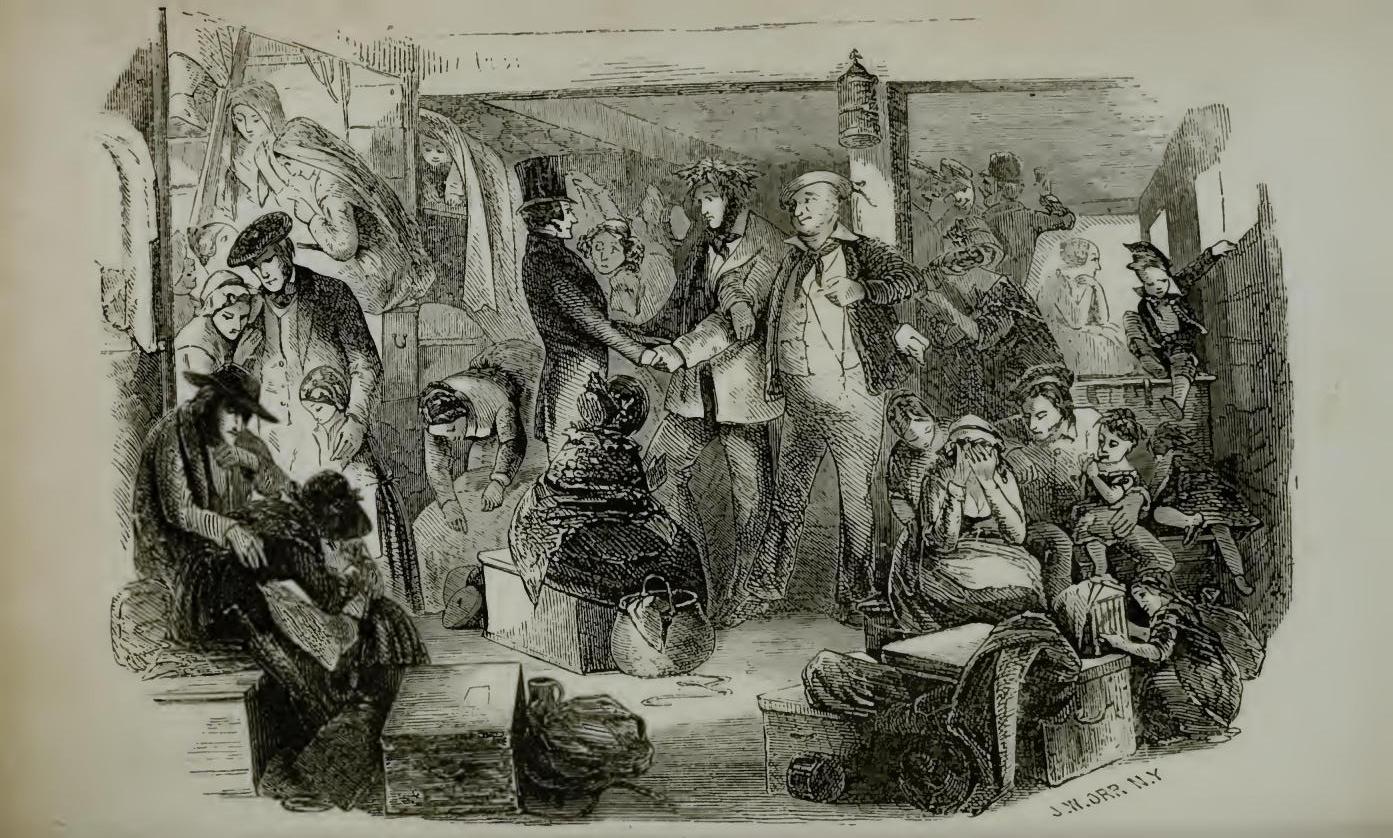
Mr. Peggotty was waiting for us on deck. He told me that Mr. Micawber had just now been arrested again (and for the last time) at the suit of Heep, and that, in compliance with a request I had made to him, he had paid the money, which I repaid him. He then took us down between decks; and there, any lingering fears I had of his having heard any rumours of what had happened, were dispelled by Mr. Micawber’s coming out of the gloom, taking his arm with an air of friendship and protection, and telling me that they had scarcely been asunder for a moment, since the night before last.
It was such a strange scene to me, and so confined and dark, that, at first, I could make out hardly anything; but, by degrees, it cleared, as my eyes became more accustomed to the gloom, and I seemed to stand in a picture by OSTADE. Among the great beams, bulks, and ringbolts of the ship, and the emigrant-berths, and chests, and bundles, and barrels, and heaps of miscellaneous baggage—‘lighted up, here and there, by dangling lanterns; and elsewhere by the yellow daylight straying down a windsail or a hatchway—were crowded groups of people, making new friendships, taking leave of one another, talking, laughing, crying, eating and drinking; some, already settled down into the possession of their few feet of space, with their little households arranged, and tiny children established on stools, or in dwarf elbow-chairs; others, despairing of a resting-place, and wandering disconsolately. From babies who had but a week or two of life behind them, to crooked old men and women who seemed to have but a week or two of life before them; and from ploughmen bodily carrying out soil of England on their boots, to smiths taking away samples of its soot and smoke upon their skins; every age and occupation appeared to be crammed into the narrow compass of the ‘tween decks.
As my eye glanced round this place, I thought I saw sitting, by an open port, with one of the Micawber children near her, a figure like Emily’s; it first attracted my attention, by another figure parting from it with a kiss; and as it glided calmly away through the disorder, reminding me of—Agnes! But in the rapid motion and confusion, and in the unsettlement of my own thoughts, I lost it again; and only knew that the time was come when all visitors were being warned to leave the ship; that my nurse was crying on a chest beside me; and that Mrs. Gummidge, assisted by some younger stooping woman in black, was busily arranging Mr. Peggotty’s goods.
‘Is there any last wured, Mas’r Davy?’ said he. ‘Is there any one forgotten thing afore we parts?’
‘One thing!’ said I. ‘Martha!’
He touched the younger woman I have mentioned on the shoulder, and Martha stood before me.
‘Heaven bless you, you good man!’ cried I. ‘You take her with you!’
She answered for him, with a burst of tears. I could speak no more at that time, but I wrung his hand; and if ever I have loved and honoured any man, I loved and honoured that man in my soul.
The ship was clearing fast of strangers. The greatest trial that I had, remained. I told him what the noble spirit that was gone, had given me in charge to say at parting. It moved him deeply. But when he charged me, in return, with many messages of affection and regret for those deaf ears, he moved me more.
The time was come. I embraced him, took my weeping nurse upon my arm, and hurried away. On deck, I took leave of poor Mrs. Micawber. She was looking distractedly about for her family, even then; and her last words to me were, that she never would desert Mr. Micawber.
We went over the side into our boat, and lay at a little distance, to see the ship wafted on her course. It was then calm, radiant sunset. She lay between us, and the red light; and every taper line and spar was visible against the glow. A sight at once so beautiful, so mournful, and so hopeful, as the glorious ship, lying, still, on the flushed water, with all the life on board her crowded at the bulwarks, and there clustering, for a moment, bare-headed and silent, I never saw.
Silent, only for a moment. As the sails rose to the wind, and the ship began to move, there broke from all the boats three resounding cheers, which those on board took up, and echoed back, and which were echoed and re-echoed. My heart burst out when I heard the sound, and beheld the waving of the hats and handkerchiefs—and then I saw her!
Then I saw her, at her uncle’s side, and trembling on his shoulder. He pointed to us with an eager hand; and she saw us, and waved her last good-bye to me. Aye, Emily, beautiful and drooping, cling to him with the utmost trust of thy bruised heart; for he has clung to thee, with all the might of his great love!
Surrounded by the rosy light, and standing high upon the deck, apart together, she clinging to him, and he holding her, they solemnly passed away. The night had fallen on the Kentish hills when we were rowed ashore—and fallen darkly upon me.