David Copperfield
CHAPTER 44. OUR HOUSEKEEPING
It was a strange condition of things, the honeymoon being over, and the bridesmaids gone home, when I found myself sitting down in my own small house with Dora; quite thrown out of employment, as I may say, in respect of the delicious old occupation of making love.
It seemed such an extraordinary thing to have Dora always there. It was so unaccountable not to be obliged to go out to see her, not to have any occasion to be tormenting myself about her, not to have to write to her, not to be scheming and devising opportunities of being alone with her. Sometimes of an evening, when I looked up from my writing, and saw her seated opposite, I would lean back in my chair, and think how queer it was that there we were, alone together as a matter of course—nobody’s business any more—all the romance of our engagement put away upon a shelf, to rust—no one to please but one another—one another to please, for life.
When there was a debate, and I was kept out very late, it seemed so strange to me, as I was walking home, to think that Dora was at home! It was such a wonderful thing, at first, to have her coming softly down to talk to me as I ate my supper. It was such a stupendous thing to know for certain that she put her hair in papers. It was altogether such an astonishing event to see her do it!
I doubt whether two young birds could have known less about keeping house, than I and my pretty Dora did. We had a servant, of course. She kept house for us. I have still a latent belief that she must have been Mrs. Crupp’s daughter in disguise, we had such an awful time of it with Mary Anne.
Her name was Paragon. Her nature was represented to us, when we engaged her, as being feebly expressed in her name. She had a written character, as large as a proclamation; and, according to this document, could do everything of a domestic nature that ever I heard of, and a great many things that I never did hear of. She was a woman in the prime of life; of a severe countenance; and subject (particularly in the arms) to a sort of perpetual measles or fiery rash. She had a cousin in the Life-Guards, with such long legs that he looked like the afternoon shadow of somebody else. His shell-jacket was as much too little for him as he was too big for the premises. He made the cottage smaller than it need have been, by being so very much out of proportion to it. Besides which, the walls were not thick, and, whenever he passed the evening at our house, we always knew of it by hearing one continual growl in the kitchen.
Our treasure was warranted sober and honest. I am therefore willing to believe that she was in a fit when we found her under the boiler; and that the deficient tea-spoons were attributable to the dustman.
But she preyed upon our minds dreadfully. We felt our inexperience, and were unable to help ourselves. We should have been at her mercy, if she had had any; but she was a remorseless woman, and had none. She was the cause of our first little quarrel.
‘My dearest life,’ I said one day to Dora, ‘do you think Mary Anne has any idea of time?’
‘Why, Doady?’ inquired Dora, looking up, innocently, from her drawing.
‘My love, because it’s five, and we were to have dined at four.’
Dora glanced wistfully at the clock, and hinted that she thought it was too fast.
‘On the contrary, my love,’ said I, referring to my watch, ‘it’s a few minutes too slow.’
My little wife came and sat upon my knee, to coax me to be quiet, and drew a line with her pencil down the middle of my nose; but I couldn’t dine off that, though it was very agreeable.
‘Don’t you think, my dear,’ said I, ‘it would be better for you to remonstrate with Mary Anne?’
‘Oh no, please! I couldn’t, Doady!’ said Dora.
‘Why not, my love?’ I gently asked.
‘Oh, because I am such a little goose,’ said Dora, ‘and she knows I am!’
I thought this sentiment so incompatible with the establishment of any system of check on Mary Anne, that I frowned a little.
‘Oh, what ugly wrinkles in my bad boy’s forehead!’ said Dora, and still being on my knee, she traced them with her pencil; putting it to her rosy lips to make it mark blacker, and working at my forehead with a quaint little mockery of being industrious, that quite delighted me in spite of myself.
‘There’s a good child,’ said Dora, ‘it makes its face so much prettier to laugh.’ ‘But, my love,’ said I.
‘No, no! please!’ cried Dora, with a kiss, ‘don’t be a naughty Blue Beard! Don’t be serious!’
‘My precious wife,’ said I, ‘we must be serious sometimes. Come! Sit down on this chair, close beside me! Give me the pencil! There! Now let us talk sensibly. You know, dear’; what a little hand it was to hold, and what a tiny wedding-ring it was to see! ‘You know, my love, it is not exactly comfortable to have to go out without one’s dinner. Now, is it?’
‘N-n-no!’ replied Dora, faintly.
‘My love, how you tremble!’
‘Because I KNOW you’re going to scold me,’ exclaimed Dora, in a piteous voice.
‘My sweet, I am only going to reason.’
‘Oh, but reasoning is worse than scolding!’ exclaimed Dora, in despair. ‘I didn’t marry to be reasoned with. If you meant to reason with such a poor little thing as I am, you ought to have told me so, you cruel boy!’
I tried to pacify Dora, but she turned away her face, and shook her curls from side to side, and said, ‘You cruel, cruel boy!’ so many times, that I really did not exactly know what to do: so I took a few turns up and down the room in my uncertainty, and came back again.
‘Dora, my darling!’
‘No, I am not your darling. Because you must be sorry that you married me, or else you wouldn’t reason with me!’ returned Dora.
I felt so injured by the inconsequential nature of this charge, that it gave me courage to be grave.
‘Now, my own Dora,’ said I, ‘you are very childish, and are talking nonsense. You must remember, I am sure, that I was obliged to go out yesterday when dinner was half over; and that, the day before, I was made quite unwell by being obliged to eat underdone veal in a hurry; today, I don’t dine at all—and I am afraid to say how long we waited for breakfast—and then the water didn’t boil. I don’t mean to reproach you, my dear, but this is not comfortable.’
‘Oh, you cruel, cruel boy, to say I am a disagreeable wife!’ cried Dora.
‘Now, my dear Dora, you must know that I never said that!’
‘You said, I wasn’t comfortable!’ cried Dora. ‘I said the housekeeping was not comfortable!’
‘It’s exactly the same thing!’ cried Dora. And she evidently thought so, for she wept most grievously.
I took another turn across the room, full of love for my pretty wife, and distracted by self-accusatory inclinations to knock my head against the door. I sat down again, and said:
‘I am not blaming you, Dora. We have both a great deal to learn. I am only trying to show you, my dear, that you must—you really must’ (I was resolved not to give this up)—‘accustom yourself to look after Mary Anne. Likewise to act a little for yourself, and me.’
‘I wonder, I do, at your making such ungrateful speeches,’ sobbed Dora. ‘When you know that the other day, when you said you would like a little bit of fish, I went out myself, miles and miles, and ordered it, to surprise you.’
‘And it was very kind of you, my own darling,’ said I. ‘I felt it so much that I wouldn’t on any account have even mentioned that you bought a Salmon—which was too much for two. Or that it cost one pound six—which was more than we can afford.’
‘You enjoyed it very much,’ sobbed Dora. ‘And you said I was a Mouse.’
‘And I’ll say so again, my love,’ I returned, ‘a thousand times!’
But I had wounded Dora’s soft little heart, and she was not to be comforted. She was so pathetic in her sobbing and bewailing, that I felt as if I had said I don’t know what to hurt her. I was obliged to hurry away; I was kept out late; and I felt all night such pangs of remorse as made me miserable. I had the conscience of an assassin, and was haunted by a vague sense of enormous wickedness.
It was two or three hours past midnight when I got home. I found my aunt, in our house, sitting up for me.
‘Is anything the matter, aunt?’ said I, alarmed.
‘Nothing, Trot,’ she replied. ‘Sit down, sit down. Little Blossom has been rather out of spirits, and I have been keeping her company. That’s all.’
I leaned my head upon my hand; and felt more sorry and downcast, as I sat looking at the fire, than I could have supposed possible so soon after the fulfilment of my brightest hopes. As I sat thinking, I happened to meet my aunt’s eyes, which were resting on my face. There was an anxious expression in them, but it cleared directly.
‘I assure you, aunt,’ said I, ‘I have been quite unhappy myself all night, to think of Dora’s being so. But I had no other intention than to speak to her tenderly and lovingly about our home-affairs.’
My aunt nodded encouragement.
‘You must have patience, Trot,’ said she.
‘Of course. Heaven knows I don’t mean to be unreasonable, aunt!’
‘No, no,’ said my aunt. ‘But Little Blossom is a very tender little blossom, and the wind must be gentle with her.’
I thanked my good aunt, in my heart, for her tenderness towards my wife; and I was sure that she knew I did.
‘Don’t you think, aunt,’ said I, after some further contemplation of the fire, ‘that you could advise and counsel Dora a little, for our mutual advantage, now and then?’
‘Trot,’ returned my aunt, with some emotion, ‘no! Don’t ask me such a thing.’
Her tone was so very earnest that I raised my eyes in surprise.
‘I look back on my life, child,’ said my aunt, ‘and I think of some who are in their graves, with whom I might have been on kinder terms. If I judged harshly of other people’s mistakes in marriage, it may have been because I had bitter reason to judge harshly of my own. Let that pass. I have been a grumpy, frumpy, wayward sort of a woman, a good many years. I am still, and I always shall be. But you and I have done one another some good, Trot,—at all events, you have done me good, my dear; and division must not come between us, at this time of day.’
‘Division between us!’ cried I.
‘Child, child!’ said my aunt, smoothing her dress, ‘how soon it might come between us, or how unhappy I might make our Little Blossom, if I meddled in anything, a prophet couldn’t say. I want our pet to like me, and be as gay as a butterfly. Remember your own home, in that second marriage; and never do both me and her the injury you have hinted at!’
I comprehended, at once, that my aunt was right; and I comprehended the full extent of her generous feeling towards my dear wife.
‘These are early days, Trot,’ she pursued, ‘and Rome was not built in a day, nor in a year. You have chosen freely for yourself’; a cloud passed over her face for a moment, I thought; ‘and you have chosen a very pretty and a very affectionate creature. It will be your duty, and it will be your pleasure too—of course I know that; I am not delivering a lecture—to estimate her (as you chose her) by the qualities she has, and not by the qualities she may not have. The latter you must develop in her, if you can. And if you cannot, child,’ here my aunt rubbed her nose, ‘you must just accustom yourself to do without ‘em. But remember, my dear, your future is between you two. No one can assist you; you are to work it out for yourselves. This is marriage, Trot; and Heaven bless you both, in it, for a pair of babes in the wood as you are!’
My aunt said this in a sprightly way, and gave me a kiss to ratify the blessing.
‘Now,’ said she, ‘light my little lantern, and see me into my bandbox by the garden path’; for there was a communication between our cottages in that direction. ‘Give Betsey Trotwood’s love to Blossom, when you come back; and whatever you do, Trot, never dream of setting Betsey up as a scarecrow, for if I ever saw her in the glass, she’s quite grim enough and gaunt enough in her private capacity!’
With this my aunt tied her head up in a handkerchief, with which she was accustomed to make a bundle of it on such occasions; and I escorted her home. As she stood in her garden, holding up her little lantern to light me back, I thought her observation of me had an anxious air again; but I was too much occupied in pondering on what she had said, and too much impressed—for the first time, in reality—by the conviction that Dora and I had indeed to work out our future for ourselves, and that no one could assist us, to take much notice of it.
Dora came stealing down in her little slippers, to meet me, now that I was alone; and cried upon my shoulder, and said I had been hard-hearted and she had been naughty; and I said much the same thing in effect, I believe; and we made it up, and agreed that our first little difference was to be our last, and that we were never to have another if we lived a hundred years.
The next domestic trial we went through, was the Ordeal of Servants. Mary Anne’s cousin deserted into our coal-hole, and was brought out, to our great amazement, by a piquet of his companions in arms, who took him away handcuffed in a procession that covered our front-garden with ignominy. This nerved me to get rid of Mary Anne, who went so mildly, on receipt of wages, that I was surprised, until I found out about the tea-spoons, and also about the little sums she had borrowed in my name of the tradespeople without authority. After an interval of Mrs. Kidgerbury—the oldest inhabitant of Kentish Town, I believe, who went out charing, but was too feeble to execute her conceptions of that art—we found another treasure, who was one of the most amiable of women, but who generally made a point of falling either up or down the kitchen stairs with the tray, and almost plunged into the parlour, as into a bath, with the tea-things. The ravages committed by this unfortunate, rendering her dismissal necessary, she was succeeded (with intervals of Mrs. Kidgerbury) by a long line of Incapables; terminating in a young person of genteel appearance, who went to Greenwich Fair in Dora’s bonnet. After whom I remember nothing but an average equality of failure.
Everybody we had anything to do with seemed to cheat us. Our appearance in a shop was a signal for the damaged goods to be brought out immediately. If we bought a lobster, it was full of water. All our meat turned out to be tough, and there was hardly any crust to our loaves. In search of the principle on which joints ought to be roasted, to be roasted enough, and not too much, I myself referred to the Cookery Book, and found it there established as the allowance of a quarter of an hour to every pound, and say a quarter over. But the principle always failed us by some curious fatality, and we never could hit any medium between redness and cinders.
I had reason to believe that in accomplishing these failures we incurred a far greater expense than if we had achieved a series of triumphs. It appeared to me, on looking over the tradesmen’s books, as if we might have kept the basement storey paved with butter, such was the extensive scale of our consumption of that article. I don’t know whether the Excise returns of the period may have exhibited any increase in the demand for pepper; but if our performances did not affect the market, I should say several families must have left off using it. And the most wonderful fact of all was, that we never had anything in the house.
As to the washerwoman pawning the clothes, and coming in a state of penitent intoxication to apologize, I suppose that might have happened several times to anybody. Also the chimney on fire, the parish engine, and perjury on the part of the Beadle. But I apprehend that we were personally fortunate in engaging a servant with a taste for cordials, who swelled our running account for porter at the public-house by such inexplicable items as ‘quartern rum shrub (Mrs. C.)’; ‘Half-quartern gin and cloves (Mrs. C.)’; ‘Glass rum and peppermint (Mrs. C.)’—the parentheses always referring to Dora, who was supposed, it appeared on explanation, to have imbibed the whole of these refreshments.
One of our first feats in the housekeeping way was a little dinner to Traddles. I met him in town, and asked him to walk out with me that afternoon. He readily consenting, I wrote to Dora, saying I would bring him home. It was pleasant weather, and on the road we made my domestic happiness the theme of conversation. Traddles was very full of it; and said, that, picturing himself with such a home, and Sophy waiting and preparing for him, he could think of nothing wanting to complete his bliss.
I could not have wished for a prettier little wife at the opposite end of the table, but I certainly could have wished, when we sat down, for a little more room. I did not know how it was, but though there were only two of us, we were at once always cramped for room, and yet had always room enough to lose everything in. I suspect it may have been because nothing had a place of its own, except Jip’s pagoda, which invariably blocked up the main thoroughfare. On the present occasion, Traddles was so hemmed in by the pagoda and the guitar-case, and Dora’s flower-painting, and my writing-table, that I had serious doubts of the possibility of his using his knife and fork; but he protested, with his own good-humour, ‘Oceans of room, Copperfield! I assure you, Oceans!’
There was another thing I could have wished, namely, that Jip had never been encouraged to walk about the tablecloth during dinner. I began to think there was something disorderly in his being there at all, even if he had not been in the habit of putting his foot in the salt or the melted butter. On this occasion he seemed to think he was introduced expressly to keep Traddles at bay; and he barked at my old friend, and made short runs at his plate, with such undaunted pertinacity, that he may be said to have engrossed the conversation.
However, as I knew how tender-hearted my dear Dora was, and how sensitive she would be to any slight upon her favourite, I hinted no objection. For similar reasons I made no allusion to the skirmishing plates upon the floor; or to the disreputable appearance of the castors, which were all at sixes and sevens, and looked drunk; or to the further blockade of Traddles by wandering vegetable dishes and jugs. I could not help wondering in my own mind, as I contemplated the boiled leg of mutton before me, previous to carving it, how it came to pass that our joints of meat were of such extraordinary shapes—and whether our butcher contracted for all the deformed sheep that came into the world; but I kept my reflections to myself.
‘My love,’ said I to Dora, ‘what have you got in that dish?’
I could not imagine why Dora had been making tempting little faces at me, as if she wanted to kiss me.
‘Oysters, dear,’ said Dora, timidly.
‘Was that YOUR thought?’ said I, delighted.
‘Ye-yes, Doady,’ said Dora.
‘There never was a happier one!’ I exclaimed, laying down the carving-knife and fork. ‘There is nothing Traddles likes so much!’
‘Ye-yes, Doady,’ said Dora, ‘and so I bought a beautiful little barrel of them, and the man said they were very good. But I—I am afraid there’s something the matter with them. They don’t seem right.’ Here Dora shook her head, and diamonds twinkled in her eyes.
‘They are only opened in both shells,’ said I. ‘Take the top one off, my love.’
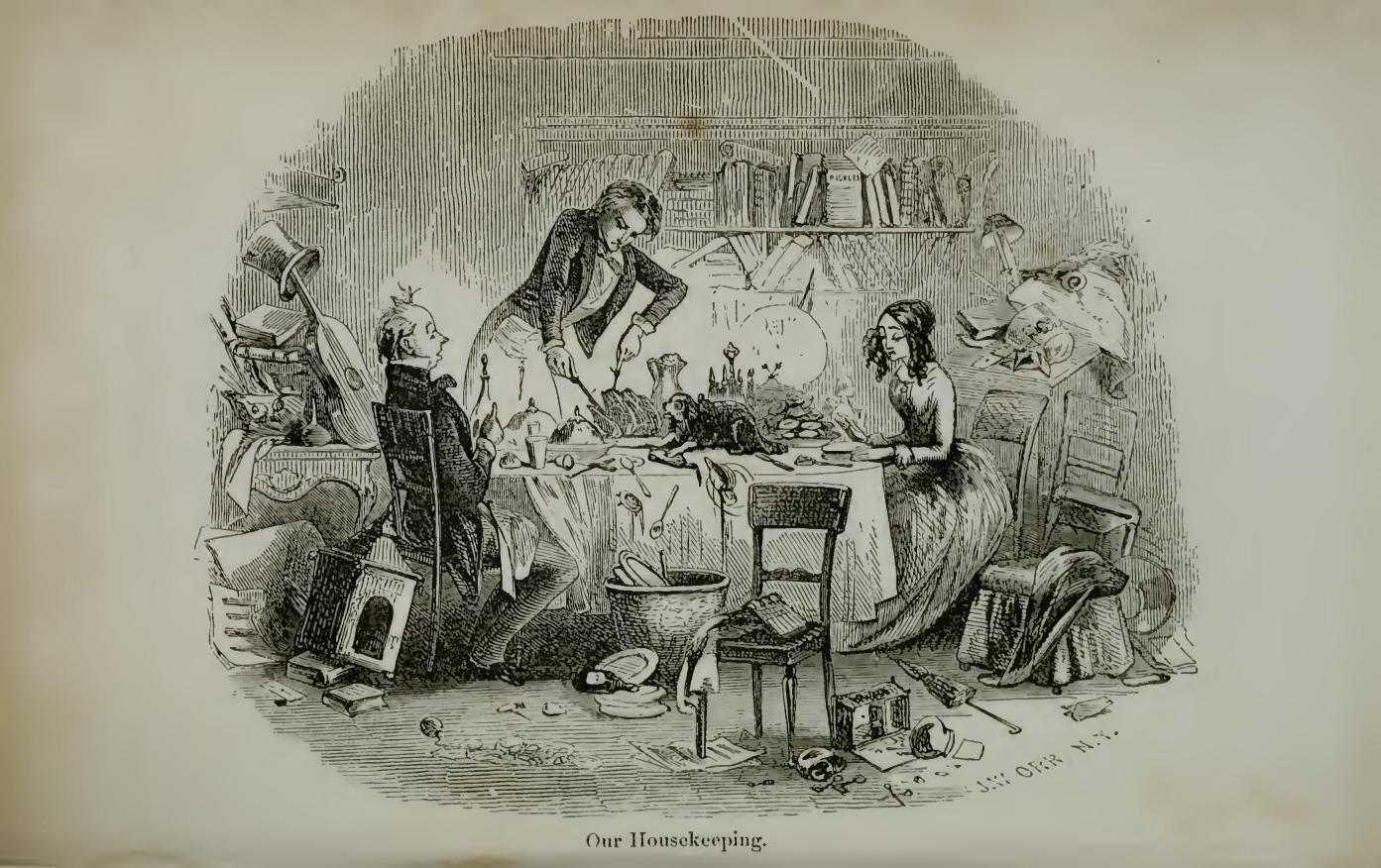
‘But it won’t come off!’ said Dora, trying very hard, and looking very much distressed.
‘Do you know, Copperfield,’ said Traddles, cheerfully examining the dish, ‘I think it is in consequence—they are capital oysters, but I think it is in consequence—of their never having been opened.’
They never had been opened; and we had no oyster-knives—and couldn’t have used them if we had; so we looked at the oysters and ate the mutton. At least we ate as much of it as was done, and made up with capers. If I had permitted him, I am satisfied that Traddles would have made a perfect savage of himself, and eaten a plateful of raw meat, to express enjoyment of the repast; but I would hear of no such immolation on the altar of friendship, and we had a course of bacon instead; there happening, by good fortune, to be cold bacon in the larder.
My poor little wife was in such affliction when she thought I should be annoyed, and in such a state of joy when she found I was not, that the discomfiture I had subdued, very soon vanished, and we passed a happy evening; Dora sitting with her arm on my chair while Traddles and I discussed a glass of wine, and taking every opportunity of whispering in my ear that it was so good of me not to be a cruel, cross old boy. By and by she made tea for us; which it was so pretty to see her do, as if she was busying herself with a set of doll’s tea-things, that I was not particular about the quality of the beverage. Then Traddles and I played a game or two at cribbage; and Dora singing to the guitar the while, it seemed to me as if our courtship and marriage were a tender dream of mine, and the night when I first listened to her voice were not yet over.
When Traddles went away, and I came back into the parlour from seeing him out, my wife planted her chair close to mine, and sat down by my side. ‘I am very sorry,’ she said. ‘Will you try to teach me, Doady?’
‘I must teach myself first, Dora,’ said I. ‘I am as bad as you, love.’
‘Ah! But you can learn,’ she returned; ‘and you are a clever, clever man!’
‘Nonsense, mouse!’ said I.
‘I wish,’ resumed my wife, after a long silence, ‘that I could have gone down into the country for a whole year, and lived with Agnes!’
Her hands were clasped upon my shoulder, and her chin rested on them, and her blue eyes looked quietly into mine.
‘Why so?’ I asked.
‘I think she might have improved me, and I think I might have learned from her,’ said Dora.
‘All in good time, my love. Agnes has had her father to take care of for these many years, you should remember. Even when she was quite a child, she was the Agnes whom we know,’ said I.
‘Will you call me a name I want you to call me?’ inquired Dora, without moving.
‘What is it?’ I asked with a smile.
‘It’s a stupid name,’ she said, shaking her curls for a moment. ‘Child-wife.’
I laughingly asked my child-wife what her fancy was in desiring to be so called. She answered without moving, otherwise than as the arm I twined about her may have brought her blue eyes nearer to me:
‘I don’t mean, you silly fellow, that you should use the name instead of Dora. I only mean that you should think of me that way. When you are going to be angry with me, say to yourself, “it’s only my child-wife!” When I am very disappointing, say, “I knew, a long time ago, that she would make but a child-wife!” When you miss what I should like to be, and I think can never be, say, “still my foolish child-wife loves me!” For indeed I do.’
I had not been serious with her; having no idea until now, that she was serious herself. But her affectionate nature was so happy in what I now said to her with my whole heart, that her face became a laughing one before her glittering eyes were dry. She was soon my child-wife indeed; sitting down on the floor outside the Chinese House, ringing all the little bells one after another, to punish Jip for his recent bad behaviour; while Jip lay blinking in the doorway with his head out, even too lazy to be teased.
This appeal of Dora’s made a strong impression on me. I look back on the time I write of; I invoke the innocent figure that I dearly loved, to come out from the mists and shadows of the past, and turn its gentle head towards me once again; and I can still declare that this one little speech was constantly in my memory. I may not have used it to the best account; I was young and inexperienced; but I never turned a deaf ear to its artless pleading.
Dora told me, shortly afterwards, that she was going to be a wonderful housekeeper. Accordingly, she polished the tablets, pointed the pencil, bought an immense account-book, carefully stitched up with a needle and thread all the leaves of the Cookery Book which Jip had torn, and made quite a desperate little attempt ‘to be good’, as she called it. But the figures had the old obstinate propensity—they WOULD NOT add up. When she had entered two or three laborious items in the account-book, Jip would walk over the page, wagging his tail, and smear them all out. Her own little right-hand middle finger got steeped to the very bone in ink; and I think that was the only decided result obtained.
Sometimes, of an evening, when I was at home and at work—for I wrote a good deal now, and was beginning in a small way to be known as a writer—I would lay down my pen, and watch my child-wife trying to be good. First of all, she would bring out the immense account-book, and lay it down upon the table, with a deep sigh. Then she would open it at the place where Jip had made it illegible last night, and call Jip up, to look at his misdeeds. This would occasion a diversion in Jip’s favour, and some inking of his nose, perhaps, as a penalty. Then she would tell Jip to lie down on the table instantly, ‘like a lion’—which was one of his tricks, though I cannot say the likeness was striking—and, if he were in an obedient humour, he would obey. Then she would take up a pen, and begin to write, and find a hair in it. Then she would take up another pen, and begin to write, and find that it spluttered. Then she would take up another pen, and begin to write, and say in a low voice, ‘Oh, it’s a talking pen, and will disturb Doady!’ And then she would give it up as a bad job, and put the account-book away, after pretending to crush the lion with it.
Or, if she were in a very sedate and serious state of mind, she would sit down with the tablets, and a little basket of bills and other documents, which looked more like curl-papers than anything else, and endeavour to get some result out of them. After severely comparing one with another, and making entries on the tablets, and blotting them out, and counting all the fingers of her left hand over and over again, backwards and forwards, she would be so vexed and discouraged, and would look so unhappy, that it gave me pain to see her bright face clouded—and for me!—and I would go softly to her, and say:
‘What’s the matter, Dora?’
Dora would look up hopelessly, and reply, ‘They won’t come right. They make my head ache so. And they won’t do anything I want!’
Then I would say, ‘Now let us try together. Let me show you, Dora.’
Then I would commence a practical demonstration, to which Dora would pay profound attention, perhaps for five minutes; when she would begin to be dreadfully tired, and would lighten the subject by curling my hair, or trying the effect of my face with my shirt-collar turned down. If I tacitly checked this playfulness, and persisted, she would look so scared and disconsolate, as she became more and more bewildered, that the remembrance of her natural gaiety when I first strayed into her path, and of her being my child-wife, would come reproachfully upon me; and I would lay the pencil down, and call for the guitar.
I had a great deal of work to do, and had many anxieties, but the same considerations made me keep them to myself. I am far from sure, now, that it was right to do this, but I did it for my child-wife’s sake. I search my breast, and I commit its secrets, if I know them, without any reservation to this paper. The old unhappy loss or want of something had, I am conscious, some place in my heart; but not to the embitterment of my life. When I walked alone in the fine weather, and thought of the summer days when all the air had been filled with my boyish enchantment, I did miss something of the realization of my dreams; but I thought it was a softened glory of the Past, which nothing could have thrown upon the present time. I did feel, sometimes, for a little while, that I could have wished my wife had been my counsellor; had had more character and purpose, to sustain me and improve me by; had been endowed with power to fill up the void which somewhere seemed to be about me; but I felt as if this were an unearthly consummation of my happiness, that never had been meant to be, and never could have been.
I was a boyish husband as to years. I had known the softening influence of no other sorrows or experiences than those recorded in these leaves. If I did any wrong, as I may have done much, I did it in mistaken love, and in my want of wisdom. I write the exact truth. It would avail me nothing to extenuate it now.
Thus it was that I took upon myself the toils and cares of our life, and had no partner in them. We lived much as before, in reference to our scrambling household arrangements; but I had got used to those, and Dora I was pleased to see was seldom vexed now. She was bright and cheerful in the old childish way, loved me dearly, and was happy with her old trifles.
When the debates were heavy—I mean as to length, not quality, for in the last respect they were not often otherwise—and I went home late, Dora would never rest when she heard my footsteps, but would always come downstairs to meet me. When my evenings were unoccupied by the pursuit for which I had qualified myself with so much pains, and I was engaged in writing at home, she would sit quietly near me, however late the hour, and be so mute, that I would often think she had dropped asleep. But generally, when I raised my head, I saw her blue eyes looking at me with the quiet attention of which I have already spoken.
‘Oh, what a weary boy!’ said Dora one night, when I met her eyes as I was shutting up my desk.
‘What a weary girl!’ said I. ‘That’s more to the purpose. You must go to bed another time, my love. It’s far too late for you.’
‘No, don’t send me to bed!’ pleaded Dora, coming to my side. ‘Pray, don’t do that!’
‘Dora!’ To my amazement she was sobbing on my neck. ‘Not well, my dear! not happy!’
‘Yes! quite well, and very happy!’ said Dora. ‘But say you’ll let me stop, and see you write.’
‘Why, what a sight for such bright eyes at midnight!’ I replied.
‘Are they bright, though?’ returned Dora, laughing. ‘I’m so glad they’re bright.’ ‘Little Vanity!’ said I.
But it was not vanity; it was only harmless delight in my admiration. I knew that very well, before she told me so.
‘If you think them pretty, say I may always stop, and see you write!’ said Dora. ‘Do you think them pretty?’
‘Very pretty.’
‘Then let me always stop and see you write.’
‘I am afraid that won’t improve their brightness, Dora.’
‘Yes, it will! Because, you clever boy, you’ll not forget me then, while you are full of silent fancies. Will you mind it, if I say something very, very silly?—-more than usual?’ inquired Dora, peeping over my shoulder into my face.
‘What wonderful thing is that?’ said I.
‘Please let me hold the pens,’ said Dora. ‘I want to have something to do with all those many hours when you are so industrious. May I hold the pens?’
The remembrance of her pretty joy when I said yes, brings tears into my eyes. The next time I sat down to write, and regularly afterwards, she sat in her old place, with a spare bundle of pens at her side. Her triumph in this connexion with my work, and her delight when I wanted a new pen—which I very often feigned to do—suggested to me a new way of pleasing my child-wife. I occasionally made a pretence of wanting a page or two of manuscript copied. Then Dora was in her glory. The preparations she made for this great work, the aprons she put on, the bibs she borrowed from the kitchen to keep off the ink, the time she took, the innumerable stoppages she made to have a laugh with Jip as if he understood it all, her conviction that her work was incomplete unless she signed her name at the end, and the way in which she would bring it to me, like a school-copy, and then, when I praised it, clasp me round the neck, are touching recollections to me, simple as they might appear to other men.
She took possession of the keys soon after this, and went jingling about the house with the whole bunch in a little basket, tied to her slender waist. I seldom found that the places to which they belonged were locked, or that they were of any use except as a plaything for Jip—but Dora was pleased, and that pleased me. She was quite satisfied that a good deal was effected by this make-belief of housekeeping; and was as merry as if we had been keeping a baby-house, for a joke.
So we went on. Dora was hardly less affectionate to my aunt than to me, and often told her of the time when she was afraid she was ‘a cross old thing’. I never saw my aunt unbend more systematically to anyone. She courted Jip, though Jip never responded; listened, day after day, to the guitar, though I am afraid she had no taste for music; never attacked the Incapables, though the temptation must have been severe; went wonderful distances on foot to purchase, as surprises, any trifles that she found out Dora wanted; and never came in by the garden, and missed her from the room, but she would call out, at the foot of the stairs, in a voice that sounded cheerfully all over the house:
‘Where’s Little Blossom?’